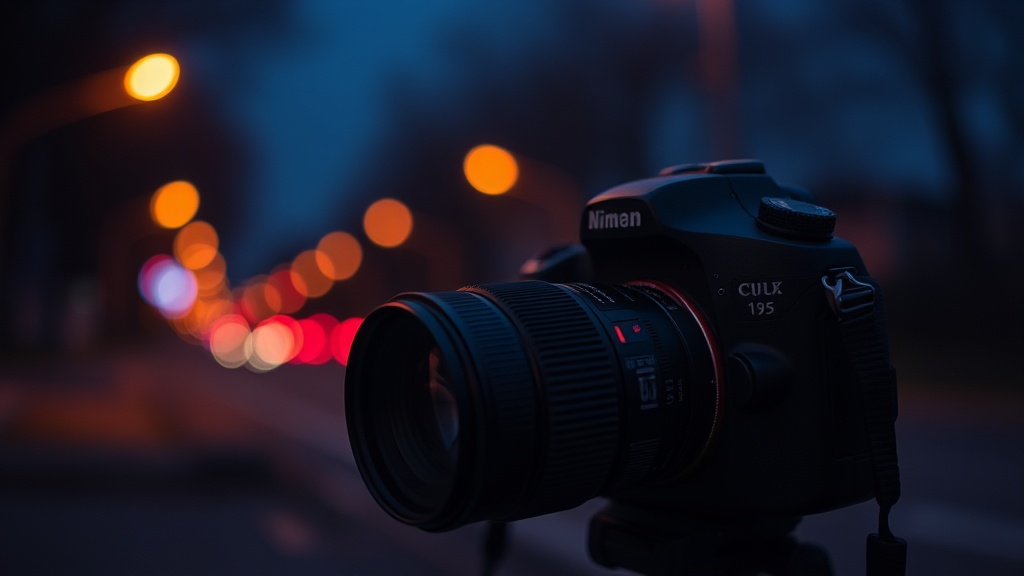
Why Your Camera's Meter Lies to You After Dark (And What to Do Instead)
Most photographers trust their camera's light meter implicitly. After all, it's calibrated by engineers who understand light better than we ever will—right? Wrong. When the sun drops below the horizon, your meter becomes about as reliable as a weather forecast from three weeks ago. It doesn't understand that you want those shadows deep and black. It panics at the sight of a dark frame and insists on overexposing everything into a muddy gray mess. This guide explains why your meter fails you at night and—more importantly—the practical techniques experienced photographers use to nail exposure when the lights go out.
Why Does My Camera Overexpose Night Scenes?
Camera meters are designed with one fundamental assumption: that the world averages out to middle gray (18% reflectance, if you want to get technical about it). In daylight, this works reasonably well. A scene with blue sky, green grass, and various colors often does average out to something close to middle gray. But night photography? You're pointing your camera at a scene that's supposed to be predominantly dark—and your meter can't handle that concept.
Your meter sees all that darkness and thinks, "This can't be right. I need to brighten this up!" So it recommends settings that push your exposure toward that middle gray target. The result? Night skies turn muddy blue-gray instead of deep black. City lights lose their punch and glow. Stars disappear into the washed-out background. You're fighting your camera's well-intentioned but completely wrong assumptions about what the scene should look like.
The problem gets worse with evaluative or matrix metering modes. These sophisticated systems try to analyze the scene, recognize patterns, and adjust accordingly. But they're trained on daylight scenarios—portraits, landscapes, sports. They don't have a "night mode" that understands you want dramatic contrast. Spot metering helps somewhat, but even then, you're still fighting against the meter's fundamental desire to make everything gray.
What's the Best Exposure Strategy for Dark Conditions?
Experienced night photographers don't fight the meter—they work around it. The most reliable approach is manual exposure with histogram verification. Start by setting your camera to manual mode. Yes, even if you normally shoot aperture priority for everything else. Night photography demands control.
Begin with your aperture based on depth of field needs—typically f/2.8 to f/4 for astrophotography where you want maximum light, or f/8 to f/11 for cityscapes where you want sharpness throughout. Set your ISO based on your camera's performance characteristics—most modern cameras handle 1600-6400 well enough, and you can always clean up noise later if needed. Then adjust your shutter speed to taste, checking the histogram after each test shot.
Speaking of histograms—this is where the magic happens. Don't trust the preview image on your LCD; it lies too (just in different ways). Instead, pull up the histogram and look at the left edge. For a proper night exposure, you want data pushing against that left wall. Not clipped—clipped shadows lose all detail—but close. If your histogram is clustered in the middle, you're overexposing. Push that exposure darker until the bulk of your data sits in the left third of the graph. National Geographic's night sky photography guide offers additional insights on reading histograms in extreme lighting conditions.
The -1 to -2 EV Compensation Rule
If you absolutely must use an automatic mode, exposure compensation becomes your best friend. Set it to -1 or -2 EV immediately when shooting night scenes. This tells your camera, "I know you think this should be brighter, but trust me—I want it darker." Some photographers even dial in -3 EV for truly dark conditions.
Bracketing helps too. Set your camera to capture three or five frames at different exposures. You'll waste some storage space and spend more time at the computer later, but you'll have options. One of those frames will be close to right, and you can blend exposures if needed for scenes with extreme dynamic range—like a cityscape with bright neon against deep shadows.
How Do Different Light Sources Affect Meter Readings?
Night photography rarely involves uniform lighting. You're dealing with street lamps, building lights, car headlights, moonlight, starlight—sometimes all in the same frame. Your meter struggles because it wants to average everything, but these different sources have wildly different color temperatures and intensities.
Tungsten street lights (the warm orange ones) confuse meters because they're dim but dominant in the frame. LED lights (those harsh blue-white ones common in modern cities) blow out easily and trick meters into underexposing surrounding areas. Mixed lighting creates metering nightmares—you meter for the bright signs and the shadows disappear; you meter for the shadows and the signs become blown-out rectangles.
The solution? Spot meter off a mid-tone area if one exists, or use the "expose for the highlights, recover the shadows" approach. In night photography, blown highlights are far worse than noisy shadows. You can always brighten shadows in post-processing (within reason), but clipped highlights are gone forever. B&H Photo's guide to long exposure night photography explains this highlight-priority approach in detail.
Manual Focus and Exposure Work Together
Here's something they don't tell you in the manual: autofocus and auto-exposure often fail together at night. When your camera can't find contrast to focus on, it also struggles to evaluate exposure. This is why manual everything becomes the norm for serious night work.
Switch to manual focus, use live view zoomed in on a bright star or distant light, and nail your focus first. Then handle exposure separately. Don't let your camera try to solve both problems simultaneously—it'll fail at both. The Light and Matter night photography exposure guide provides excellent technical background on why these systems struggle after dark.
Should I Use Different Metering Modes for Astrophotography vs. Cityscapes?
Absolutely. The metering approach that works for star photography will ruin a cityscape, and vice versa. For astrophotography—capturing the Milky Way, constellations, or star trails—you want the stars properly exposed without trailing (usually meaning higher ISO and shorter shutter speeds, following the 500 rule or NPF rule for sharp stars). Your meter will scream that everything is underexposed. Ignore it. Check the histogram: you want the peak somewhere in the left half, but not slammed against the left edge where you lose star detail.
For cityscapes, you have more latitude. You can use longer exposures, lower ISOs, and smaller apertures. The meter still lies, but you have more room to recover in post because you're not pushing the camera's limits. Here, bracketing becomes particularly valuable. Capture one frame for the buildings, another for the sky, and blend them together. The meter might get one or the other right, but rarely both.
Light painting scenarios present unique challenges. Your base exposure for the background should be dark—again, trust the histogram, not the meter. Then add your light painting, checking that you don't blow out the painted areas. The meter will see those bright flashlight bursts and try to darken everything. You have to override it, sometimes dramatically, to get both the painted subject and the background properly exposed.
Practical Testing in the Field
Here's a workflow that actually works: Set up your composition. Switch to manual mode. Take a test shot at what you think is the right exposure. Check the histogram. Is the data clustered in the middle? You're overexposing—speed up the shutter or stop down. Is it all crammed against the left wall with a vertical line indicating clipping? You're underexposing—slow down or open up. Is it spread through the left third with some breathing room before the edge? You're in the zone.
Shooting RAW gives you even more flexibility. You can underexpose slightly more than you would with JPEG, knowing you can recover shadow detail later. Just don't clip those highlights. In night photography, a slightly dark exposure is infinitely better than a slightly bright one. The dark one looks moody and intentional. The bright one looks like a mistake.
Your camera's meter isn't evil—it's just working with bad information. Once you understand its limitations and learn to compensate (or bypass it entirely), night photography becomes far more predictable. Trust your eyes, verify with the histogram, and don't be afraid to ignore every suggestion your camera makes. After all, you're the photographer. The camera's just a tool—and sometimes, it's a tool that needs to be told when to stop helping.